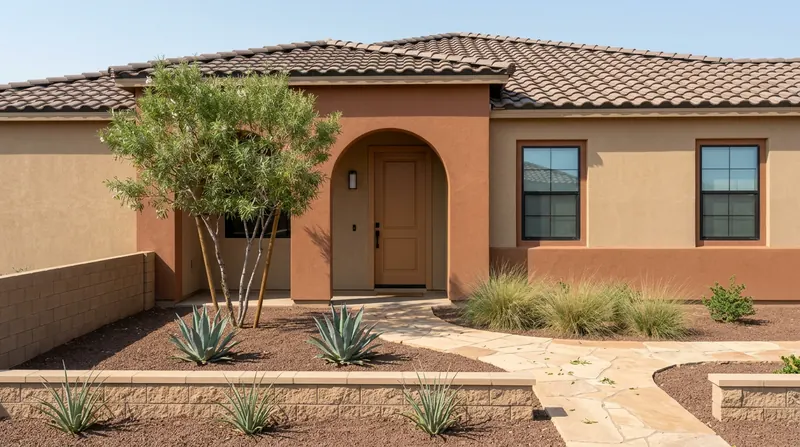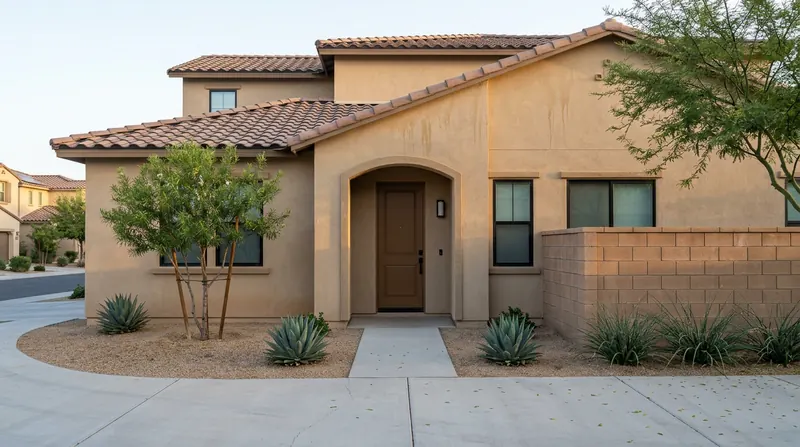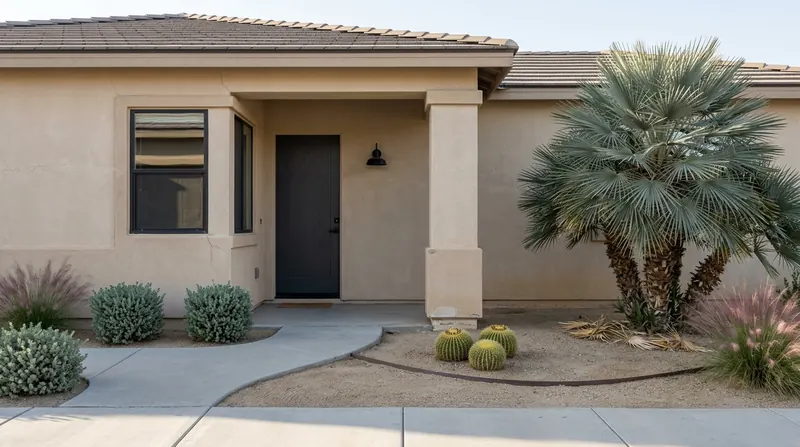
Why would a buyer choose a home with a $40 monthly association fee over a nearly identical home with a $200 one, and end up further behind in five years?
That is the question most Las Vegas buyers never ask, because the math looks obvious on the surface. A no-HOA home reads as the cheaper home. You keep the difference every month, you skip the resale paperwork, you never sit through a board meeting about paint colors. But an HOA fee in a master-planned community is not really a subscription for landscaping and a pool schedule. It is a mandatory, collective reserve fund, and when you buy a home without one, you are not avoiding that cost. You are agreeing to self-insure the same risk alone, with no pool of other owners and no professional reserve study behind you.
Las Vegas gives you an unusually clean way to see this trade-off, because the city still has real inventory on both sides of it: newer master-planned villages where the reserve fund is built into the closing statement, and a cluster of historic, largely HOA-free neighborhoods inside the 215 loop where it was never built at all.
The Fee You're Not Paying Doesn't Disappear
The clearest proof that an HOA fee functions as insurance shows up at Sun City Summerlin, the valley's largest 55-plus community. As of the community's most recently published fee schedule in 2025, buyers there paid a monthly master association fee of $230.16, plus a one-time contribution at closing called a New Owner Reserve Account, or NORA fee, set at $5,000. That fee has one job: it tops off the community's shared repair and replacement fund every time a home changes hands, so the reserve keeps pace with age and use rather than falling behind.
A buyer in a no-HOA neighborhood makes no equivalent contribution to anything, because there is no shared fund to contribute to. The roof, the HVAC system, the drainage grading around the foundation, all of it sits on that single owner's balance sheet. When something fails, there is no reserve study that already planned for it and no group of neighbors who pre-funded the fix. The cost still exists. It has just moved from a collectivized, professionally managed account to one household's savings, with no advance warning of when the bill comes due.
What a Master-Plan Fee Is Actually Buying
Summerlin makes the mechanism easy to see because its fee structure is layered and disclosed. As of the 2026 assessment year, Summerlin North's monthly master fee sits at $74, Summerlin South at $76, and Summerlin West at $69, with the Summerlin Council's $37 share already folded into those totals according to reporting in the Las Vegas Review-Journal. Most properties also carry a separate village or sub-association fee on top of that, and Las Vegas REALTORS MLS data from July 2026 puts the blended median across active Summerlin listings at roughly $109 a month, with the middle half of listings ranging from $69 up toward $232 depending on the village and its amenities.
That fee funds landscaping and gates, but it also funds something buyers rarely think about until they sell: a professional reserve study that forecasts when shared infrastructure needs replacement and sets aside money for it years in advance. It shows up again at resale, when Nevada law requires sellers to hand buyers a disclosure package documenting the association's financial standing. In a two-association Summerlin sale, sellers typically order two of these packages, each running $160 to $250 in 2026, for a combined $320 to $500 in fees most sellers do not anticipate until they see the settlement statement. That cost is annoying, but it is also proof of a functioning system: a buyer can actually see the reserve balance before removing contingencies, because Nevada law forces the association to show its work.
The Historic Neighborhoods Built Before Any of This Existed
None of this layered structure existed when Las Vegas built its first subdivisions. John S. Park, listed on the National Register of Historic Places in 2003, was one of the city's original neighborhoods, with curvilinear streets and homes dating to the 1930s and 1940s sitting half a mile from the Strip. Huntridge, just south of Charleston Boulevard along Maryland Parkway, grew up around the same era to house workers and military personnel, and its small 1,000 to 2,000 square foot cottages still cluster around the landmark Huntridge Theater and Huntridge Circle Park. Beverly Green, developed starting in 1955 across 80 acres and more than 500 homes, is a designated historic district built by architects working in an eclectic mid-century style, with angular rooflines and custom detailing that no production builder replicates today. Scotch 80s, dating to the 1950s, was actually Southern Nevada's first master-planned community, though its HOA structure never carried forward the layered reserve model that later master plans like Summerlin adopted.
None of these neighborhoods were built with a master association, a village sub-association, or a reserve study in mind, because that financing model did not exist yet in Las Vegas residential development. As of June 2026, the Beverly Green area carried 314 active MLS listings with a median list price of $365,000, spanning original-condition ranches near $300,000 up to fully renovated homes approaching $600,000, and the HOA line on most of those listings runs $0 to $50 a month, reflecting the pre-master-plan era these homes were built in. Citywide, no-HOA single-family inventory in Las Vegas clusters in a handful of recognizable pockets: the older grid streets around the Arts District, and established tracts across the 89104, 89108, 89102, and 89110 zip codes.
The Math Nobody Runs Before Making an Offer
The instinct to treat that $150 to $200 monthly difference as pure savings is where buyers get the comparison backward. A Summerlin buyer paying into a village reserve fund is buying into a system where hundreds of homeowners are jointly funding the eventual replacement of shared infrastructure, spreading both the cost and the risk across the whole community. A Beverly Green or Huntridge buyer paying $0 to $50 a month is not spreading anything. They are the entire risk pool, and the home they are buying was built decades before any HOA reserve study existed to plan for its aging systems.
This does not make the historic-neighborhood purchase a bad decision. It makes it a decision that requires its own math, done up front rather than discovered later. A buyer choosing the no-HOA route should ask what a comparable Summerlin buyer is actually funding every month, then decide honestly whether they are prepared to self-fund an equivalent cushion for their own roof, HVAC system, and plumbing on a home that may be 50 to 70 years old. Skipping that exercise is also where the most common underwriting surprise comes from on the master-plan side: buyers who see one HOA number on a listing and get caught at loan underwriting when a lender discovers a second, undisclosed village fee that pushes their debt-to-income ratio past what they qualified for.
| Historic no-HOA neighborhoods (Beverly Green example) | Standard Summerlin village stack | |
|---|---|---|
| Typical monthly association fee, 2026 | $0 to $50 | $69 to $232 for the middle half of listings, blended median around $109 |
| Resale disclosure package required at sale | None | $160 to $250 per association, often two required, $320 to $500 combined |
| One-time reserve contribution at closing | None | Some sections charge new-owner reserve fees; Sun City Summerlin's NORA fee was $5,000 as of 2025 |
| Who funds major shared-system repairs | The individual owner, entirely | A collective reserve fund, professionally studied and funded monthly |
| Lender review at underwriting | Standard, no association questionnaire | HOA financials, litigation search, and reserve study confirmation required |
What to Actually Inspect When There's No Reserve Study Behind You
Because there is no HOA-commissioned reserve study to lean on in a historic-neighborhood purchase, the inspection period has to do that work instead. Homes built in Las Vegas between the 1930s and the 1970s carry a predictable set of aging systems worth prioritizing before removing contingencies: the roof and its remaining service life, the HVAC system given how hard desert heat cycles run compressors, the plumbing type and condition, and the grading and drainage around the foundation, since decades of monsoon runoff can shift a slab in ways a newer, engineered subdivision was designed to prevent. None of this shows up in a reserve study because none of these homes has one. It shows up only if the buyer's inspector goes looking for it.
Which Model Fits Which Buyer
A buyer who wants predictable monthly costs, a professionally managed repair timeline, and the reassurance of a documented reserve balance is generally better served by a master-planned village, even with the layered fees and the added underwriting scrutiny that comes with it. A buyer who wants full control over renovations, values architectural character over uniformity, and is financially prepared to self-fund major repairs on an older home is often better served by a historic district like Beverly Green, John S. Park, or Huntridge, where the lower monthly cost is real but comes with the full weight of ownership resting on one household instead of hundreds.
Neither choice is wrong. The mistake is treating the HOA line on a listing sheet as a cost to minimize rather than a mechanism to understand. Once a buyer sees what that fee is actually funding, the comparison between a $69 Summerlin West assessment and a $0 Beverly Green listing stops being a simple savings calculation and becomes what it actually is: two different ways of paying for the same eventual repair bill.
Frequently Asked Questions
Does buying a no-HOA home in Las Vegas make financing harder? Not typically. Conventional, FHA, and VA financing all apply to no-HOA single-family homes without the additional condo or PUD questionnaire a lender requires when an association is involved, since there is no association financial review or litigation search needed.
What should I ask before buying in a historic no-HOA district? Ask for the roof's age and any repair history, the plumbing material and any prior repiping, the HVAC system's age, and whether the seller has documentation of any foundation or drainage work. None of this will appear in a disclosure package the way it would with an HOA, so it has to come from direct inspection and seller disclosure.
Are historic Las Vegas neighborhoods entirely free of any restrictions? Some, like John S. Park and Beverly Green, carry local historic district designation, which can affect exterior modifications even without a private HOA. City zoning still applies everywhere. What is absent is the private CC&R layer that governs paint colors, landscaping, and architectural approval in most master-planned villages.
If you are weighing a historic Las Vegas property against a master-planned alternative and want the real numbers run for your specific situation, Casanova Realty can walk through the full carrying-cost comparison before you write an offer. Schedule a strategy consultation and get the math sorted before it becomes a surprise at closing.